TL;DR
- Vaults, while popular in DeFi, come with risks beyond smart contract vulnerabilities
- The USR collapse exposed how curators can allocate users’ idle funds to fund broken markets
- BSKTs fix this by never giving managers power over users’ capital. All they can influence is their weighted allocation
When the USR stablecoin depegged, most eyes were on whether Reserve Labs would survive the $80 million exploit. As the dust settles, the industry is realizing that this story has a broader impact on DeFi, particularly the category of protocols that’ve gained huge popularity in recent years: onchain asset managers powered by vaults.
Their job: providing an investment contract that would automatically execute a strategy to (ideally) grow the investors’ assets worth by a target percentage. An attractive proposition and therefore unsurprising that protocols in the business of it have amassed billions of dollars in TVL.
The surge in them has been enabled by risk curators, professionals specialized in providing risk assessments and management for DeFi services, usually very closely intertwined with the platforms that rely on their assessments.
Take Morpho, the second-largest lending protocol, which got started as a place to earn yield on USDC on Base, and has since gone multi-chain. Their offering includes multiple vaults curated by Gauntlet, a well-known risk curator.
What Vaults Do
A vault is essentially a smart contract that accepts deposits from users and then executes a pre-determined strategy to achieve its stated goals (increasing the value of the locked assets). Their selling point is streamlining countless interactions like staking, lending, and swapping into one and performing them on behalf of users.
There are a great variety of vaults, named after their focus area, such as:
- Fixed yield vaults: attempting to earn defined returns often by relying on lending protocols
- LP Vaults: optimizing capital within AMM pools
- Delta Neutral vaults: implement strategies to offset market exposure by holding positions neutralizing the risk
Vaults automate what used to be manual in the early days of crypto. As the space matures, we’ve seen new vault configurations that rely more heavily on the assessment of risk curators. Risk curators can take on a more active role in deploying users’ capital.
Vault Risk Curation, Gone Wrong
As happened following the USR exploit. When a hacker figured out how to mint $50 million in stablecoin with just $100k in collateral, this wasn’t great for Reserve Labs. The stablecoin depegged, and the project decided to freeze its functions until the vulnerability had been fixed.
Yet the impact wasn’t limited to them, as with any stablecoin in DeFi, there is a market for it. In this case, it was a USR/USDC pair where the yield shot up, flagging it as an “in-demand” market. Consequently, Gauntlet and other curators allocated funds to it, providing exit liquidity to the market.
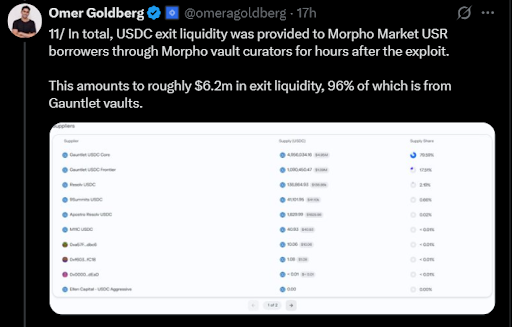
The risk curators were asleep at the wheel, highlighting to investors in these vaults that the risks aren’t limited to potential protocol vulnerabilities. If curators can move idle funds around, what else can they do?
Vaults have enabled significant innovation and financial participation, yet real risks remain. We believe that there’s a different way to leverage others’ wisdom to grow one’s digital asset portfolio: BSKTs.
How ERC-7621 Solves the “Trust Me Bro”
At Alvara, we know about the power of onchain asset management, but found that existing options with vaults were not quite what worked for our mission. That’s why we developed a new token standard, ERC-7621, that allows the creation of a tokenized basket of assets, which:
- Provides an interface for managers to change assets and weightings
- Gives investors tokens to represent their stake
- Guarantees backing at any time
This means that when investing in a BSKT on Alvara, investors never lock up their capital for others’ use. Instead, it’s more like they’re buying into the potential gains of another while knowing they can exit the second they have a slight doubt. Portfolio managers never have access to users’ funds.
BSKT managers on Alvara are focused on discretionary asset management, actively curating a portfolio of crypto assets to try to outperform the market. Our approach is purely meritocratic, where the best managers rise to the top.
There are no predefined fixed yields, only ambitious, aspiring asset managers competing while giving everyone else the opportunity to take part in their success. The situation, as it happened with risk curators supplying capital to a broken market, can’t happen.
The worst that could happen is that the chosen assets are underperforming, but that’s a very different, more transparent risk. BSKTs do not ask users to trust them; they are fully transparent, and managers cannot touch or move users’ funds.
Anyone can create their own BSKT or invest in another’s. Transparent. Meritocratic. Self-custodial.
Want to give it a try? Create your first BSKT here.